Prishtina History
The area of Prishtina has a long history, in its vincity archaeological discoveries have been found which date back to the early neolithical ages.The remains of Ulpiana, near Prishtina :Southeast of the city, the remains of Ulpiana were discovered, the center of the Illyrian province of Dardania. Ulpiana was founded in the 2nd century during the rule of Emperor Trajan, and renewed in the 6th century during the rule of Justinian, after whom it was called Iustinana Secunda. According to inscriptions on the monuments from Ulpiana, it is apparent that it was one of the most beautiful cities of the Illyrian Dardania, as it was often reffered to as Ulpiana Splendissima. A number of articles were discovered here such as coins, ceramics, weapons, jewlery, all of which are exhibited at the Museum of History of Kosova in Prishtina.After the incursions of Slavs and barbarians during the early Middle Ages, the destroyed town of Ulpiana was abandoned, creating the locality for the new town of Prishtina.During Serbian rule, Prishtina was a major political center. Near Prishtina is the site of the Battle of Kosova (1389), in which a Balkan alliance, led by Serbian Prince Lazar, fought against the Ottoman army. The battle marked the begining of Ottoman rule of the region.

In the 19th century, according to the writings of A. Bue (1838), Prishtina had 7000-9000 inhabitants, and Hilferding (1857) wrote that the town had 1500 houses, one fifth of which were Serbian. In the middle of the 19th century, Prishtina was famous for its fairs (panair) of various crafts and trade articles, especially goat hide and hair articles, coppersmiths, pottery, embroidery, etc.During World War II, Prishtina (with around 16,000 inhabitants), was included in the zone occupied by Italians, and was the center of the prefecture with the same name.Historical monuments near Prishtina include the Gracanica Monastery, built in 1321 on the basis of an older church, and the Mausoleum of Sultan Murat, reconstructed in 1850 by Hurshid Pasha.
Prishtina EducactionPrishtina is the most significant high education center of Kosova. The University of Prishtina, founded in 1970, is located here with its 13 faculties (colleges). Prishtina is also home of the Academy of Arts and Sciences of Kosova which gathers Kosova's most prominent intellectuals, the Institute of Albanology, and the Institute of History. Unfortunately, after the Belgrade authorities revoked Kosova's autonomy and took over its administration, in an attempt to close down these institutions deprived them of their buildings and offices, forcing them to find alternative working space around the city. In addition, the Serb police frequently harrass members, professors, students and employees of these institutions.
Something about Prishtina

Prishtina is the capital of Kosova and it has about 250.000 population. Most of them are the Albanian nationality and a small percent of other nationalities. It is a crossroad of significant international routes, for the inersection of arterial roads connection the Western and Esastern Europ with the near East. Not very far from Prishtina, situated in the southeast of the city, the great antique town of Ulpiana, the center of the Illyrian Dardania was founded in the beginning of the second centry AD.
This is Prishtina City

Go to PrishtinaGo to Prishtina is part of Visit Dardania travel and tourist guides to Kosova. The following is a list of website providing travel and tourist information about Kosova. Find out everything you want to know about Kosovar tourism, including the top destinations, guides for discovering Kosovar historical and cultural heritage, directions for exploring the unspoiled natural beauties, activities and things you can do while in Kosova, and other practical information, such as country facts and figures, accommodation (hotels, motels, guesthouses, hostels), wining and dining (finest restaurants), arts and entertainment, events, maps, local transport, local currency, telephones, international post, local phrases and more.
Kosova > Prishtina
 Mother Teresa Street |
 Bill Clinton Boulevard |
The area of Prishtina has a long history, in its vincity archaeological discoveries have been found which date back to the early neolithical ages.
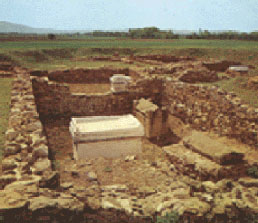
 The remains of Ulpiana, near Prishtina |
Southeast of the city, the remains of Ulpiana were discovered, the center of the Illyrian province of Dardania. Ulpiana was founded in the 2nd century during the rule of Emperor Trajan, and renewed in the 6th century during the rule of Justinian, after whom it was called Iustinana Secunda. According to inscriptions on the monuments from Ulpiana, it is apparent that it was one of the most beautiful cities of the Illyrian Dardania, as it was often reffered to as Ulpiana Splendissima. A number of articles were discovered here such as coins, ceramics, weapons, jewlery, all of which are exhibited at the Museum of History of Kosova in Prishtina.
After the incursions of Slavs and barbarians during the early Middle Ages, the destroyed town of Ulpiana was abandoned, creating the locality for the new town of Prishtina.
During Serbian rule, Prishtina was a major political center. Near Prishtina is the site of the Battle of Kosova (1389), in which a Balkan alliance, led by Serbian Prince Lazar, fought against the Ottoman army. The battle marked the begining of Ottoman rule of the region.
 The Gracanica Monastery (14th century) near Prishtina |
Prishtina developed in the 14th and 15th century as a mining and trading center of the Novoberde and the Mount Kopaonik (Albanik) mining industry. During the Ottoman rule in the region, it was an important administrative center, seat of the ruling Pasha, and for a while it was the center of the Kosova Vilayet.
During the Austrian-Turkish Wars of the 17th century, the Albanian population of Prishtina under the command of Pjet'r Bogdani fought aside the Austrian army against the Ottoman Turks. During Piccollominni's campaign and later Austrian campaigns, Prishtina suffered considerably, as was the case during the 1859 and 1863 fires.

A rendering of the building of the Academy of Arts and Sciences
(18th century), an example of Prishtina's traditional architecture
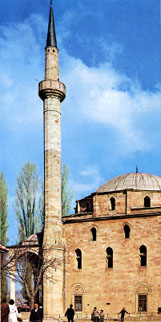
 Faith Mosque (15th century) |
In the 19th century, according to the writings of A. Bue (1838), Prishtina had 7000-9000 inhabitants, and Hilferding (1857) wrote that the town had 1500 houses, one fifth of which were Serbian. In the middle of the 19th century, Prishtina was famous for its fairs (panair) of various crafts and trade articles, especially goat hide and hair articles, coppersmiths, pottery, embroidery, etc.
During World War II, Prishtina (with around 16,000 inhabitants), was included in the zone occupied by Italians, and was the center of the prefecture with the same name.
Historical monuments near Prishtina include the Gracanica Monastery, built in 1321 on the basis of an older church, and the Mausoleum of Sultan Murat, reconstructed in 1850 by Hurshid Pasha.
Prishtina became the capital of Kosova after World War II. Up to this point, Prishtina had retained its appearance as an oriental town, but the intensive modernization of Prishtina in socialist Yugoslavia had managed to completely change the structure and look of the city, and had even destroyed the old ,arshia (shopping street) and 18th and 19th century buildings to replace them with new ones.
The old narrow cobble stone streets and low mostly mud made houses were replaced by new modern complexes and wide streets, and attractive public buildings: the Assembly Building, Radio Station, the Television of Prishtina, Press and Publishing Hall, the University Library, several banking centers, etc.
 The Grand Hotel in Prishtina |
After Serbia revoked Kosova's autonomous status in 1989, virtually all public buildings and companies of Prishtina were taken over by Serbian appointed managements, which dismissed virtually all Albanian employees.
Prishtina is the most significant high education center of Kosova. The University of Prishtina, founded in 1970, is located here with its 13 faculties (colleges). Prishtina is also home of the Academy of Arts and Sciences of Kosova which gathers Kosova's most prominent intellectuals, the Institute of Albanology, and the Institute of History. Unfortunately, after the Belgrade authorities revoked Kosova's autonomy and took over its administration, in an attempt to close down these institutions deprived them of their buildings and offices, forcing them to find alternative working space around the city. In addition, the Serb police frequently harrass members, professors, students and employees of these institutions.
The most popular localities of Prishtina are Kurrizi (The Spine) in the Dardania quarter and Qafa (The Neck) near the center of the city, which feature many shops, cafés and hangouts, opened in tunnels built within residential buildings.
Short guide to Prishtina*
Nowhere else in the Mediterranean Europe will you be greeted by such an overwhelming warmth and hospitality by local people. Prishtina, the capital of Kosova, embraces and shares the culture that knows how to grasp the little pleasures of life.
Slow down, don’t rush, relax – Prishtina people offer you a great choice of trendy cafés, bars and restaurants to taste their remarkably excellent food and coffee as well as experience their positive approach toward life. Prishtina is a wonderful modern city featuring remnants of antique cultures: Illyrian, Roman, Byzantium, and Ottoman. Once discovered Prishtina divulges its charm and beauty, and you are already in love - with a Wonderful Prishtina!
How to Get There?
The following table provides information about flights arriving to Prishtina International Airport (PRN) from various countries. See Table 1.
For budget-minded travellers, the following bus services operate to Prishtina from a number of European countries. See Table 2.
Shuttle buses for Prishtina city centre leave every other hour and cost €3. Alternatively, taxis are available for the price of €20. It takes approximately 20 minutes to reach the centre of Prishtina. You have touched down in Prishtina when you notice a huge poster of Bill Clinton welcoming you to the city.
Four Seasons in Prishtina Spring Prishtina is awakening itself from the winter sleep in late March. Snow melting, trees blossoming, cafés filling up with people – Prishtina is blushing with its youthful and cheerful mood. In order to take that special breath of spring-feel in the air, you must go to Gërmia Park – a green and delightful place to spend a lovely afternoon with your friends or your family. A jogger or a barbeque lover, you will appreciate its greenery and fresh air whereas the children’s attention will be captured by the little zoo.Not to forget though, one must attend a famous book fair held in the Youth and Sports Centre of Prishtina, every May. Well known Albanian writers gather to celebrate and appreciate the fast-growing literature world of Kosova. New and old books are being presented, criticised and praised. The book fair lasts for a whole week – this is an event not to miss. Even if you are just a mere passer-by, you will be welcomed there and looked after by the local people.SummerIn summer, Prishtina is in its most thriving and entertaining time of the year. This is the time when Prishtina reveals all its beauty and energy. You walk into the centre of town, and find yourself among thousands of shops, cafés, and bars. Bill Clinton and Mother Teresa boulevards will blister with a healthy laughter and cheerfulness of the local people.This is the time of the year when Prishtina invites you to chill into a huge outdoor swimming pool – probably the largest in the whole of Europe. The heat of the sun and relaxation in the cool waters - what else can a person wish for his ultimate pleasure?Summer is a perfect time for you to explore the historical sights situated around Prishtina city. Shielded in the land of endless legends, Turbia of Sinan Pasha, Graçanica Monastery, the remains of Ancient Ulpiana, and Marble Cave, will tell you the history from the eyes of ordinary Kosovars, who were there to witness changes happen.AutumnIn autumn, Prishtina’s carefree and high-spirited summer lifestyle turns into a busy and lively flurry of finest food markets. It is the time when farmers from the farthest villages of Kosova bring their summer fruits and vegetables to the heart of Prishtina. It is a pleasant experience to get caught up in between the stalls full of fresh and famous Kosovar pairs and most importantly, millions and millions of sacks of different peppers. The sellers are there to make sure you do not leave the market without tasting every single fruit or nut. It is simply delightful!After a busy day in the market, you now wish to sit back and make most of Prishtina’s theatre season. Autumn offers you a great choice of cultural activities. If you fancy having a good laugh, you should go and watch a comedy in a local theatre. If you wish to learn about Albanian folklore, you may want to attend a concert performed by the best singers and dancers of the region.Picturesque markets and rich festive cultural life complement the colourful beauty of the autumn in Prishtina.WinterThe remarkable beauty of Prishtina is such that it truly endures and exposes all four distinct seasons of the year. Winter in Prishtina is usually cold. Yet, it does not necessarily mean that you cannot enjoy it. In fact, wherever you walk, in the streets or in the parks, you appreciate elegant frost of the trees and piles of white snow reflecting bright sunshine into your face.It is probably the calmest season of the year. Although, Prishtina cafés and restaurants are never empty. You must pop in a Qebabtore or Burektore – a typical Albanian eating place – to try traditional pies and pastries served with yogurt and fresh tomato salad. What’s more, you may want to join a customary ritual of drinking nice warm tea in oriental style.Still, to fully appreciate and enjoy winter time in Prishtina you should go skiing to Gërmia Mountain, which is situated 6 km east of Prishtina at 1100m above the sea level. Fun and thrill of skiing will be even more enchanted when you realise that Gërmia Mountain grants you the most vivid panorama. You will be able to enjoy a clear view of the dramatic outline of Kosova Valley and the caps of Sharri Mountains.
THIS SITE IS UNDER CONSTRUCTION. THANK YOU.
*Alternative spellings: Prishtinë, Pristina.