Hasan Prishtina (1873 in Vushtrri - 1933) was briefly prime minister of Albania in December 1921. He studied politics and law in Istanbul. His real last name was "Berisha" but he changed it when elected a parliament member, during 1908-1912, of the Turkish National Parliament in Istanbul.
After the Ottoman Government did not keep their promises for more rights and independence to the Albanian nation, Hasan Prishtina and several other prominent Albanian intellectuals started organizing the Albanian National Movement. He together with Isa Boletini and Bajram Curri took the responsibility to start the Movement in Kosovo.
He was elected a minister in the Albanian government of Ismail Qemaili in 1913.
In 1918, Hasan Prishtina, Kadri Prishtina (Hoxhë Kadriu), Bajram Curri and many others create the comittee National Protection of Kosovo]] and had their representatives in Rome and Albania.
He was in charge of the delegation in december 1919, participating to protect the rights of Albania in the Peace Conference of Paris, where he requested the re-unification of Kosovo and Albania.
He was the main organizer of Lushnja Congress in 1920.
Later in 1921 he was elected as the prime minister of the Albanian government, but resigned due to contradictions he had with Ahmet Zogu, the King of Albania. He remained just a member of the parliament.
After the establishment of good relations with the Slovene, Croat and Serbian Empire of 1922 and Ahmet Zogu's government, Hasan Prishtina and many other leaders from Kosovo were persecuted. There are claims that Ahmet Zogu even authorized the Serbian troops to search for him in Albania's territory.
In the end of february of 1923, Hasan Prishtina and Bajram Curri organized an uprisal of Albanians in Kosovo, against the Serbian troops installed there. This uprisal was crushed, as no assistance was provided by Ahmet Zogu.
After this uprisal, several persecutions of Albanians in Kosovo followed.
Hasan Prishtina is known to have been very rich, and sold almost all his property to finance the education of Albanians from Kosovo in universities around Europe, and for the armed resistance, during all his life.
He was imprisoned by Belgrade for a period, was released in 1931, and was killed in Thesaloniki in 1933 by king Zog and Serbian government.
Prishtina History
The area of Prishtina has a long history, in its vincity archaeological discoveries have been found which date back to the early neolithical ages.The remains of Ulpiana, near Prishtina :Southeast of the city, the remains of Ulpiana were discovered, the center of the Illyrian province of Dardania. Ulpiana was founded in the 2nd century during the rule of Emperor Trajan, and renewed in the 6th century during the rule of Justinian, after whom it was called Iustinana Secunda. According to inscriptions on the monuments from Ulpiana, it is apparent that it was one of the most beautiful cities of the Illyrian Dardania, as it was often reffered to as Ulpiana Splendissima. A number of articles were discovered here such as coins, ceramics, weapons, jewlery, all of which are exhibited at the Museum of History of Kosova in Prishtina.After the incursions of Slavs and barbarians during the early Middle Ages, the destroyed town of Ulpiana was abandoned, creating the locality for the new town of Prishtina.During Serbian rule, Prishtina was a major political center. Near Prishtina is the site of the Battle of Kosova (1389), in which a Balkan alliance, led by Serbian Prince Lazar, fought against the Ottoman army. The battle marked the begining of Ottoman rule of the region.

In the 19th century, according to the writings of A. Bue (1838), Prishtina had 7000-9000 inhabitants, and Hilferding (1857) wrote that the town had 1500 houses, one fifth of which were Serbian. In the middle of the 19th century, Prishtina was famous for its fairs (panair) of various crafts and trade articles, especially goat hide and hair articles, coppersmiths, pottery, embroidery, etc.During World War II, Prishtina (with around 16,000 inhabitants), was included in the zone occupied by Italians, and was the center of the prefecture with the same name.Historical monuments near Prishtina include the Gracanica Monastery, built in 1321 on the basis of an older church, and the Mausoleum of Sultan Murat, reconstructed in 1850 by Hurshid Pasha.
Prishtina EducactionPrishtina is the most significant high education center of Kosova. The University of Prishtina, founded in 1970, is located here with its 13 faculties (colleges). Prishtina is also home of the Academy of Arts and Sciences of Kosova which gathers Kosova's most prominent intellectuals, the Institute of Albanology, and the Institute of History. Unfortunately, after the Belgrade authorities revoked Kosova's autonomy and took over its administration, in an attempt to close down these institutions deprived them of their buildings and offices, forcing them to find alternative working space around the city. In addition, the Serb police frequently harrass members, professors, students and employees of these institutions.
Something about Prishtina

Prishtina is the capital of Kosova and it has about 250.000 population. Most of them are the Albanian nationality and a small percent of other nationalities. It is a crossroad of significant international routes, for the inersection of arterial roads connection the Western and Esastern Europ with the near East. Not very far from Prishtina, situated in the southeast of the city, the great antique town of Ulpiana, the center of the Illyrian Dardania was founded in the beginning of the second centry AD.
This is Prishtina City

Go to PrishtinaGo to Prishtina is part of Visit Dardania travel and tourist guides to Kosova. The following is a list of website providing travel and tourist information about Kosova. Find out everything you want to know about Kosovar tourism, including the top destinations, guides for discovering Kosovar historical and cultural heritage, directions for exploring the unspoiled natural beauties, activities and things you can do while in Kosova, and other practical information, such as country facts and figures, accommodation (hotels, motels, guesthouses, hostels), wining and dining (finest restaurants), arts and entertainment, events, maps, local transport, local currency, telephones, international post, local phrases and more.
Kosova > Prishtina
 Mother Teresa Street |
 Bill Clinton Boulevard |
The area of Prishtina has a long history, in its vincity archaeological discoveries have been found which date back to the early neolithical ages.
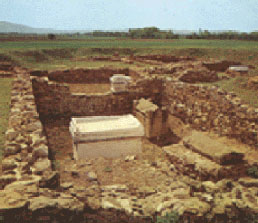
 The remains of Ulpiana, near Prishtina |
Southeast of the city, the remains of Ulpiana were discovered, the center of the Illyrian province of Dardania. Ulpiana was founded in the 2nd century during the rule of Emperor Trajan, and renewed in the 6th century during the rule of Justinian, after whom it was called Iustinana Secunda. According to inscriptions on the monuments from Ulpiana, it is apparent that it was one of the most beautiful cities of the Illyrian Dardania, as it was often reffered to as Ulpiana Splendissima. A number of articles were discovered here such as coins, ceramics, weapons, jewlery, all of which are exhibited at the Museum of History of Kosova in Prishtina.
After the incursions of Slavs and barbarians during the early Middle Ages, the destroyed town of Ulpiana was abandoned, creating the locality for the new town of Prishtina.
During Serbian rule, Prishtina was a major political center. Near Prishtina is the site of the Battle of Kosova (1389), in which a Balkan alliance, led by Serbian Prince Lazar, fought against the Ottoman army. The battle marked the begining of Ottoman rule of the region.
 The Gracanica Monastery (14th century) near Prishtina |
Prishtina developed in the 14th and 15th century as a mining and trading center of the Novoberde and the Mount Kopaonik (Albanik) mining industry. During the Ottoman rule in the region, it was an important administrative center, seat of the ruling Pasha, and for a while it was the center of the Kosova Vilayet.
During the Austrian-Turkish Wars of the 17th century, the Albanian population of Prishtina under the command of Pjet'r Bogdani fought aside the Austrian army against the Ottoman Turks. During Piccollominni's campaign and later Austrian campaigns, Prishtina suffered considerably, as was the case during the 1859 and 1863 fires.

A rendering of the building of the Academy of Arts and Sciences
(18th century), an example of Prishtina's traditional architecture
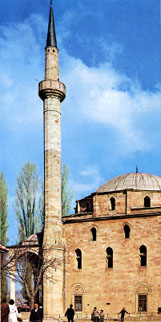
 Faith Mosque (15th century) |
In the 19th century, according to the writings of A. Bue (1838), Prishtina had 7000-9000 inhabitants, and Hilferding (1857) wrote that the town had 1500 houses, one fifth of which were Serbian. In the middle of the 19th century, Prishtina was famous for its fairs (panair) of various crafts and trade articles, especially goat hide and hair articles, coppersmiths, pottery, embroidery, etc.
During World War II, Prishtina (with around 16,000 inhabitants), was included in the zone occupied by Italians, and was the center of the prefecture with the same name.
Historical monuments near Prishtina include the Gracanica Monastery, built in 1321 on the basis of an older church, and the Mausoleum of Sultan Murat, reconstructed in 1850 by Hurshid Pasha.
Prishtina became the capital of Kosova after World War II. Up to this point, Prishtina had retained its appearance as an oriental town, but the intensive modernization of Prishtina in socialist Yugoslavia had managed to completely change the structure and look of the city, and had even destroyed the old ,arshia (shopping street) and 18th and 19th century buildings to replace them with new ones.
The old narrow cobble stone streets and low mostly mud made houses were replaced by new modern complexes and wide streets, and attractive public buildings: the Assembly Building, Radio Station, the Television of Prishtina, Press and Publishing Hall, the University Library, several banking centers, etc.
 The Grand Hotel in Prishtina |
After Serbia revoked Kosova's autonomous status in 1989, virtually all public buildings and companies of Prishtina were taken over by Serbian appointed managements, which dismissed virtually all Albanian employees.
Prishtina is the most significant high education center of Kosova. The University of Prishtina, founded in 1970, is located here with its 13 faculties (colleges). Prishtina is also home of the Academy of Arts and Sciences of Kosova which gathers Kosova's most prominent intellectuals, the Institute of Albanology, and the Institute of History. Unfortunately, after the Belgrade authorities revoked Kosova's autonomy and took over its administration, in an attempt to close down these institutions deprived them of their buildings and offices, forcing them to find alternative working space around the city. In addition, the Serb police frequently harrass members, professors, students and employees of these institutions.
The most popular localities of Prishtina are Kurrizi (The Spine) in the Dardania quarter and Qafa (The Neck) near the center of the city, which feature many shops, cafés and hangouts, opened in tunnels built within residential buildings.